Memory models: A guide to how your memories are mapped
Exploring how memories can be visualised using models

Memories: sensory, short-term, long-term… You’ve likely heard these terms before, but what do they actually mean?
I thought we could look at two models of memory: the Multi Store Model and the Working Memory Model. These models are often covered in psychology or neuroscience classes/courses, but not everyone is familiar with them, so I thought I would discuss them today.
Let’s begin:
Multi Store Model
One of the first models of memory was the Multi Store Model, proposed by psychologists Atkinson and Shiffrin in 1968. This model is based on the belief that humans process information in the same way as a computer: a way in which is passive, unitary and linear.
According to the model, information is held in stores without actively involving cognitive processing or manipulation of information (passive), each memory store is a single unit (unitary) and information flows in a sequential order (linear).
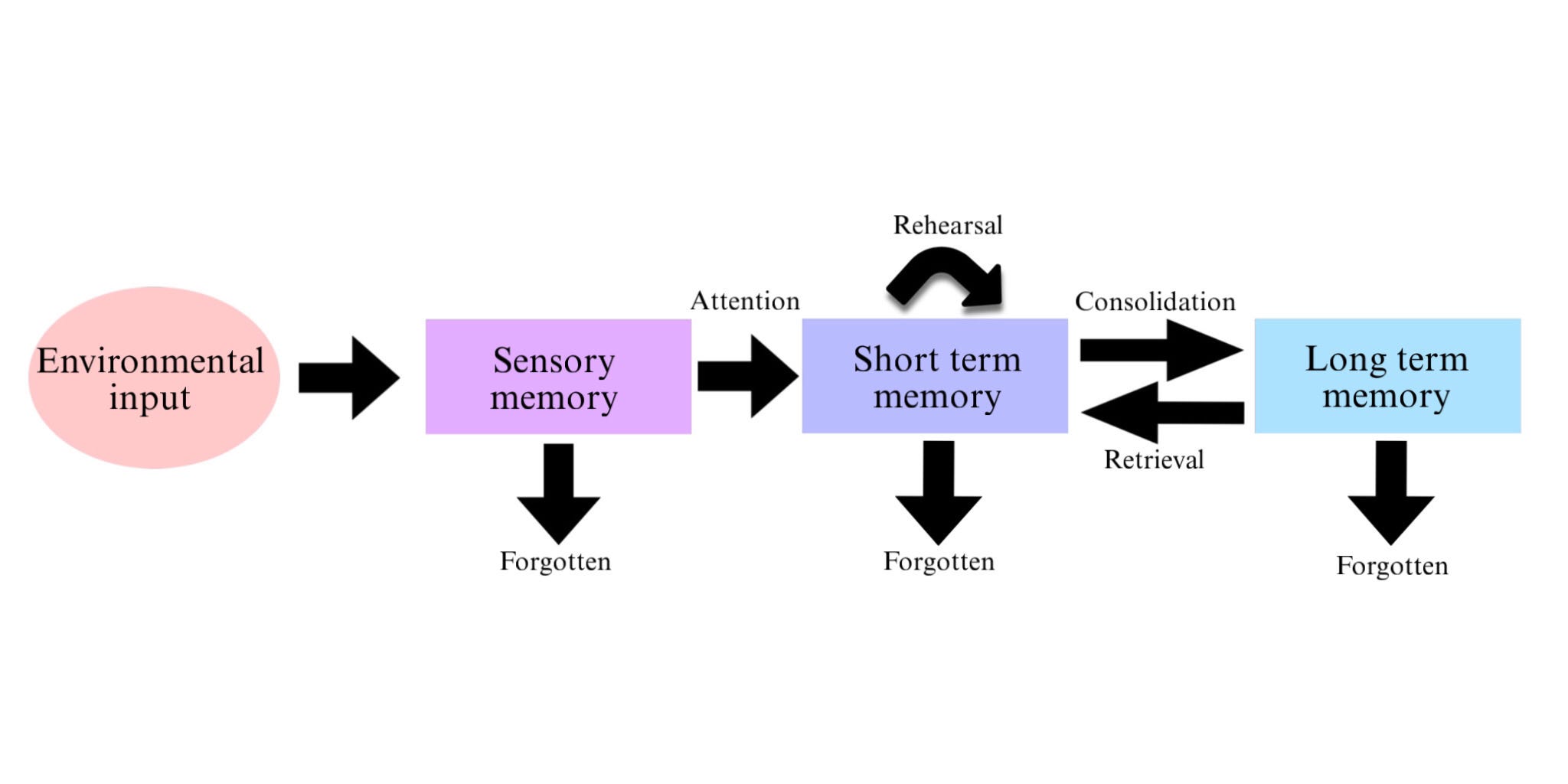
The diagram below shows the order in which information must move in order to go into storage, according to the Multi Store Model - it flows from the sensory register, to short-term memory and then long-term memory, with factors such as attention, rehearsal and consolidation preventing information from being forgotten:
Made on Picsart
One of the ways in which we can distinguish between the three stores is by looking at three variables: coding (how information is processed in order for it to be stored in the memory), capacity (the amount of information that can be stored) and duration (how long the information is held in the store).
Let’s look at each store individually:
Sensory memory: Sensory memory (sometimes called the sensory register) stores brief sensory events such as sights, sounds or smells.
Coding: Memories are coded into the sensory memory based on which sense is being used. For example, they may be haptic (tactile memories), iconic (visual memories), or echoic (auditory memories).
Capacity: The sensory memory store has a large capacity, storing all sensory experiences we encounter in daily life.
Duration: Information stays in the sensory memory store for around 0.5 seconds.
Short-term memory: Short-term memory is a temporary storage system that process incoming sensory memories before they become long-term memories.
Coding: Information is coded into the short-term memory primarily acoustically (based on spoken words and rhythms).
Capacity: Cognitive psychologist George Miller suggests that short-term memory has a capacity of 7±2 pieces of information.
Duration: Information stays in the short-term memory for around 18-30 seconds.
Long-term memory: Long-term memory is a continuous store of information. Not all long-term memories are remembered equally strongly - sometimes memory prompts are needed to retrieve them.
Coding: Information is mainly coded into the long-term memory semantically (based on the meanings of words, context and existing knowledge).
Capacity: Long-term memory has an unlimited capacity.
Duration: Long-term memory also has an unlimited duration.
There are actually several types of long-term memories: procedural, semantic and episodic:
Procedural: Memories of types of motor skills and how to do things. It is an implicit type of memory, meaning that it is recalled automatically rather than us consciously retrieving it.
Semantic: Memories of knowledge and language, such as words, concepts and facts about the world around us. It is an explicit type of memory, meaning that we consciously try to remember and recall it.
Episodic: Memories of events we have personally experienced, specifically particular places, times and visual imagery associated with the event. This is also an explicit time of memory, meaning that we consciously remember and recall it.
Evaluating the Multi Store Model
One of the strengths of the Multi Store Model is that there are case studies to support it, such as the case study of HM conducted by psychologist Milner.
HM had damage to the hippocampus after undergoing surgery for his epilepsy and he consequently developed anterograde amnesia. Interestingly, HM still had the ability to learn new motor skills, meaning his procedural memory was intact, but he couldn’t form any new semantic or episodic memories. He also had a working memory (the ability to temporarily hold information while completing tasks), but it was clearly no longer connected to his long-term memory, since he couldn’t form semantic and episodic memories.
This case study supports the Multi Store Model because it shows the distinction between short-term and long-term memory, suggesting that they are separate stores. However, one of the issues with case studies in research is that they involve small samples of patients with unique cases, so results cannot necessarily be generalised to the entire population.
Further research to support the Multi Store Model comes from studies of Korsakoff’s syndrome, which causes brain damage and may affect chronic alcoholics. Korsakoff’s syndrome severely impairs long-term memory, but leaves short-term memory relatively unaffected, which supports the idea that they are separate memory stores.
There are several limitations to the Multi Store Model. For instance, it doesn’t account for the fact that there are different types of short-term and long-term memory. Furthermore, it is unlikely that the process of memory is perfectly linear like the model suggests - it’s likely more of an interaction between stores.
Working Memory Model
The second model we will discuss is the Working Memory Model, which was developed by psychologists Baddeley and Hitch in 1974. This model, unlike the Multi Store Model, only focuses on short-term memory, showing us a more dynamic view of how it functions.
The main idea behind the Working Memory Model is that information in your short-term memory is constantly manipulated with and ‘worked on’, rather than passively staying there, as the Multi Store Model might suggest.
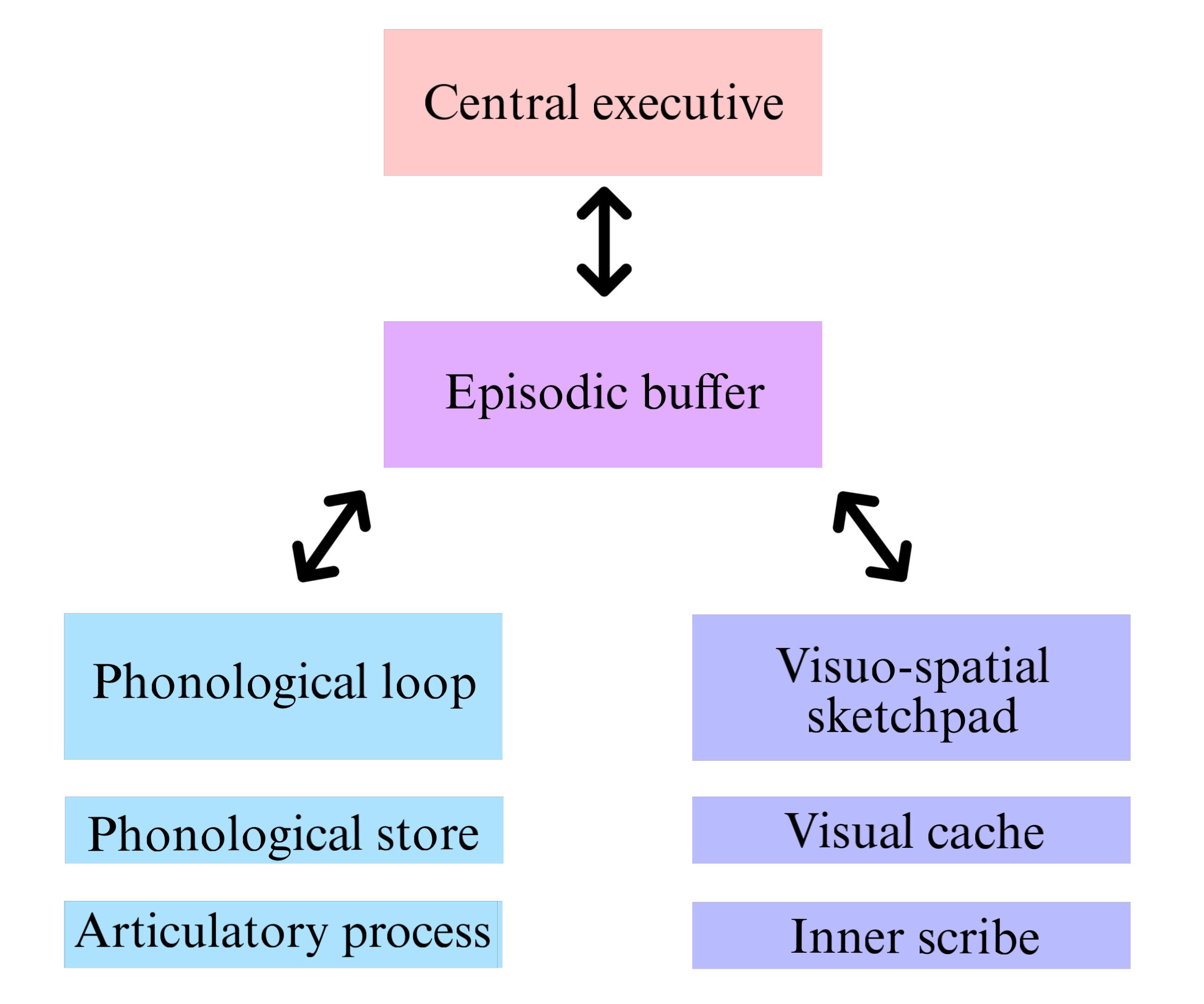
The Working Memory Model is divided into four main stores (two of which have sub-components), as shown by the diagram below:
Made on Picsart
Let’s take a look at how the model describes each of these stores:
Central executive: The central executive is the main ‘organiser’ of information within the short-term memory, rather than being a store of information. Its role is to filter incoming information into the other stores and decide how attention will be divided between them.
It has a limited capacity, meaning that it can only deal with one strand of information at a time. There is still a lot of vagueness around the central executive, mainly because we don’t know the specific measurable processes it uses to divide attention.
Phonological loop: The phonological loop deals with auditory information and the order in which it is heard. Because this store deals with acoustic information, sometimes confusion can occur if words sound similar.
It is split into two sub-components:
Phonological store: Also called the ‘inner ear’. It holds recently heard spoken information for around 1.5 - 2 seconds.
Articulatory process: Also called the ‘inner voice’. It rehearses the recently heard spoken information from the phonological store and is linked to speech production, especially when turning written material into spoken word.
Visuo-spatial sketchpad: The visuo-spatial sketchpad temporarily stores visual and spatial information, as well as the relationship between them, enabling us to navigate and interact with our physical environment. This information is coded and rehearsed in the form of mental pictures.
It is split into two sub-components:
Visual cache: A passive store of visual data.
Inner scribe: A rehearsal mechanism recording arrangements of objects in the visual field.
Episodic buffer: The episodic buffer is a general store which accounts for both visual and acoustic information, integrating information from the long-term memory, central executive, phonological loop and visuo-spatial sketchpad. It can also ‘bind’ different types of information to help us maintain a sense of time.
Evaluating the Working Memory Model
Once again, we can use case studies as support for this memory model:
KF was a patient who had suffered brain damage in a motorcycle accident and was left with short-term memory impairment. However, his memory problems were much greater for auditory information than visual, suggesting that his brain damage was restricted to the phonological loop.
The study of KF actually supports both the Multi Store Model and the Working Memory Model because his long-term memory was unaffected, suggesting that short-term and long-term memory are different stores. However, the study also provides evidence specifically for the Working Memory Model, as KF’s visuo-spatial sketchpad was unaffected by the injury, suggesting that it is a separate store to the phonological loop, which did suffer damage.
However, again, the case study suffers from issues with generalisation to the wider population due to how specific it was to the patient.
There are also a few general limitations of the Working Memory Model, such as the vagueness of the central executive and the fact that it only describes working memory, leaving unanswered questions about the long-term memory. Also, many of the experiments used to create the model in the first place were lab-based, meaning that they were very artificial and didn’t necessarily represent real-life situations.
Looking at these two main models of memory we have in neuroscience research, we can see that although they both have their own limitations, they give us a direction to focus research in and provide a basic framework for how memory might work.
Hope this was an interesting read!